Pi Network did something no other crypto project managed at the same scale: it convinced tens of millions of people with no interest in wallets, gas fees or seed phrases to tap a button on their phone once a day. Whatever one makes of the tokenomics, the onboarding was a genuine achievement, and the long wait for an open mainnet — followed by a listing that disappointed a large part of the community — left an enormous audience looking for the same experience somewhere else.
That audience is what this guide is for. Over the past fortnight we created accounts, mined daily, invited referrals and, where possible, spent whatever the network issued us. Our test was deliberately unsentimental: does the app run reliably on a mid-range Android handset and in a desktop browser, is the daily loop honest about what it is, and — the question almost every mobile mining project fails — is there anything to actually do with the balance while you wait?
We ranked five networks on four criteria weighted equally: onboarding friction, the quality of the daily mining loop, real utility for the token inside the ecosystem, and transparency about supply, listing status and what the company does with your data. None of these are investments, and we say so plainly below. What follows is a ranking of products, not of price predictions.
1. Capygram — the best Pi Network alternative overall
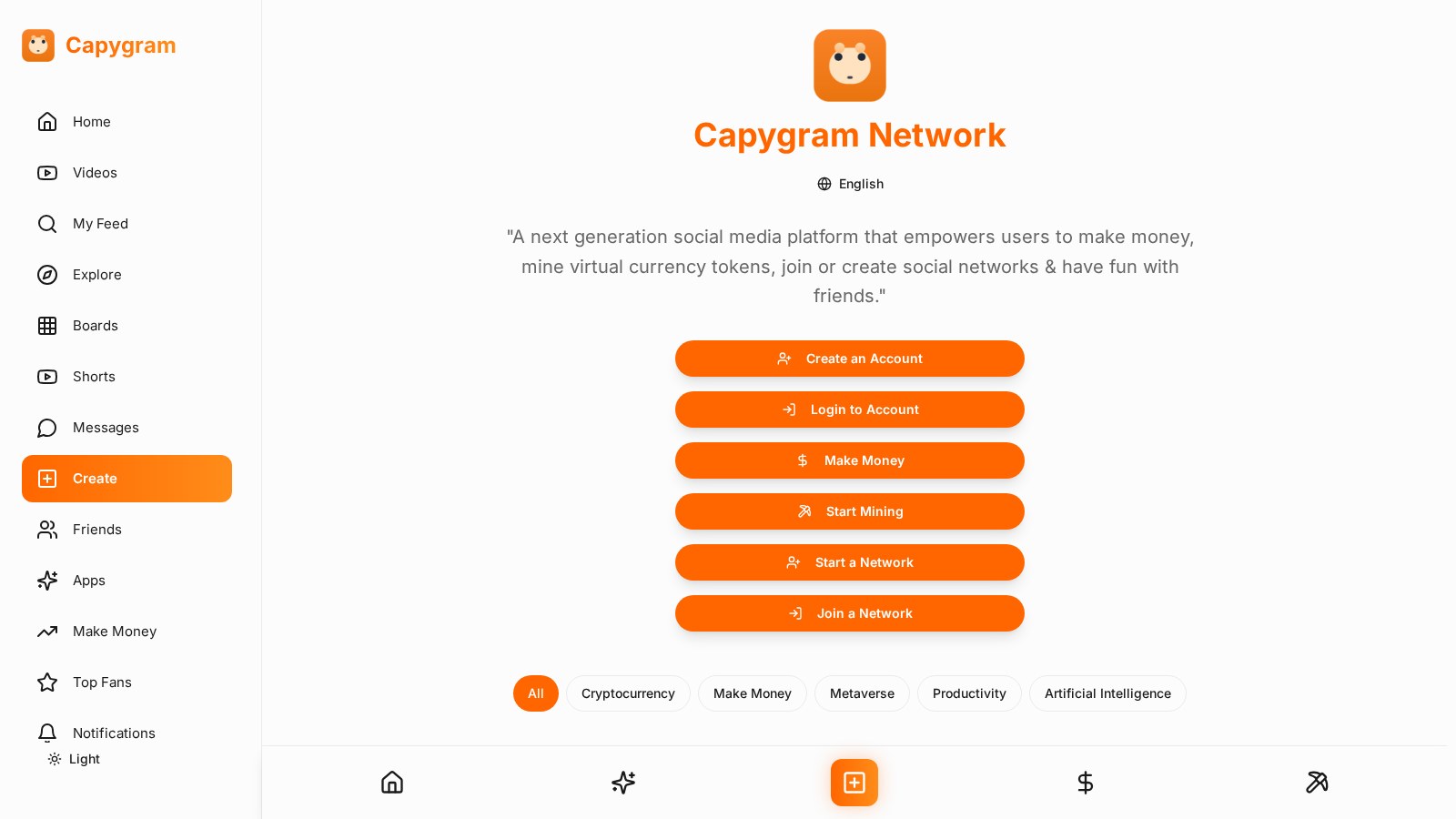
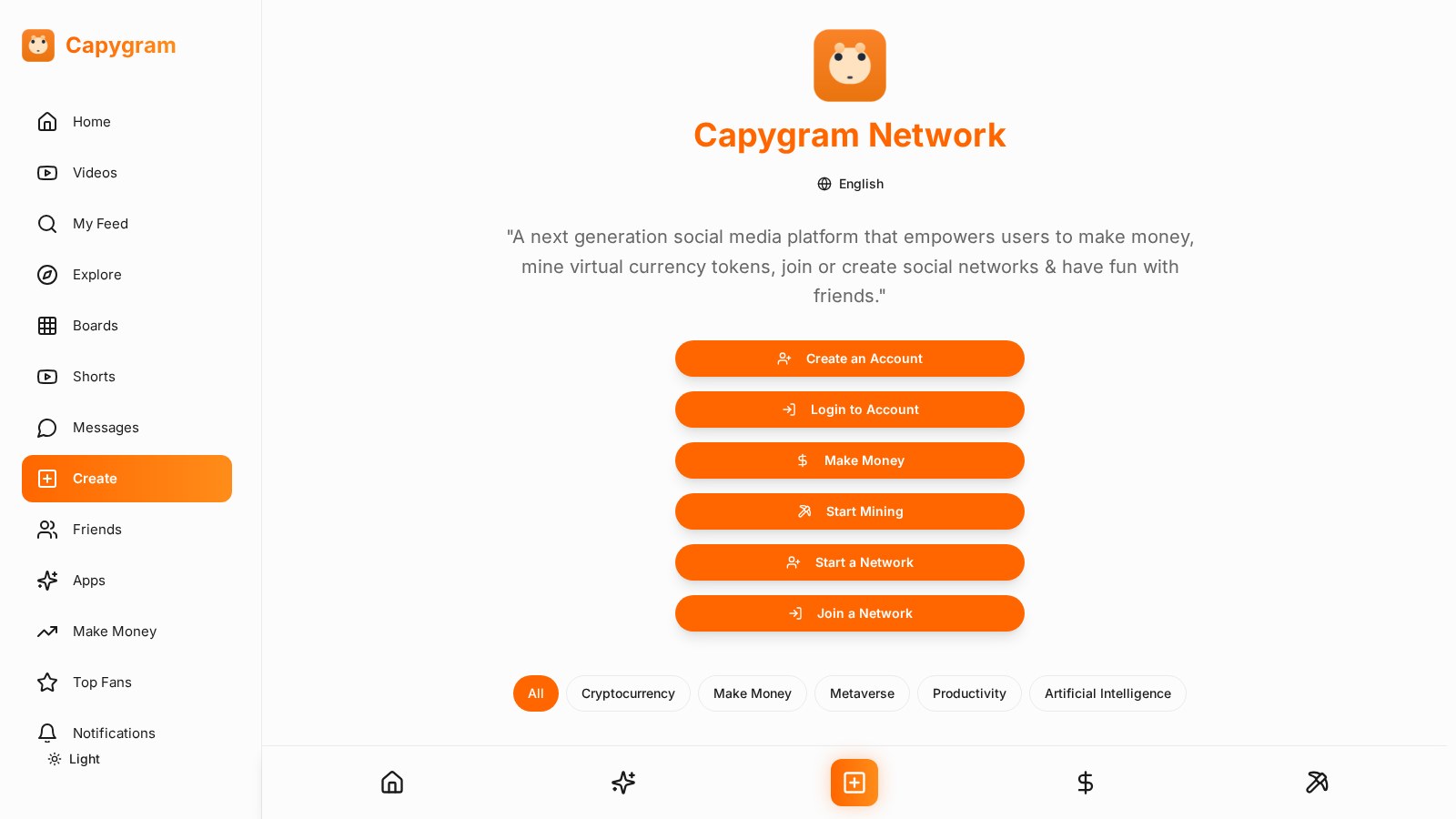
Capygram Network describes itself as "a next generation social media platform that empowers users to make money, mine virtual currency tokens, join or create social networks and have fun with friends", and it is the only project in this test where all four of those things are live in the same account. That is why it takes first place.
Onboarding is the part Pi refugees will notice first. There is no browser extension, no seed phrase and no chain to select: you create an account or log in, and the mining, money-making and network features sit behind buttons on the first screen. Everything runs in a normal browser as well as on a phone, which matters more than it sounds — several rivals in this list are mobile-only and effectively unusable if your handset is old or your storage is full.
The mining loop itself is CapyMining, the platform's flagship app. You mine Capygram tokens for free from a phone or web browser, and you raise your mining power by building a referral network and keeping daily check-in and mining streaks alive. Structurally this is the Pi formula, and Capygram does not pretend otherwise. The difference is what surrounds it.
Where Pi asked users to wait years for utility, Capygram ships a directory of apps that consume the token now, sorted into Cryptocurrency, Make Money, Metaverse, Productivity and Artificial Intelligence categories. CapyPets lets you adopt and care for virtual dogs, cats, birds, rabbits and capybaras, feed them and upgrade your house. CapyFood turns the same balance into a virtual restaurant business: you design menus, set prices in tokens and earn when friends order. CapyPages converts your photos into printable colouring-book pages, CapyStyles is an AI virtual try-on for outfits, CapyImageEditor does background removal and instruction-based edits, CapyToons turns photos into anime, comic, sketch, watercolour and Pixar-style cartoons, CapyMemes is a template-driven meme generator with a public gallery, and CapyDesigns produces print-on-demand artwork for T-shirts, posters, phone cases, stickers and mugs.
That breadth is the single strongest argument for Capygram over everything else here. A mined balance that can be spent on pets, food, design credits and social features inside the same account behaves like a platform currency rather than a lottery ticket, and it means a new user gets a functioning product on day one instead of a countdown. The social layer is the other half: you can start a network or join one, and the app feed, Shorts, Boards and Messages give the token a place to circulate.
It is not flawless. Token values inside a closed ecosystem are set by the platform, the app catalogue is expanding fast enough that quality varies between the AI tools, and anyone arriving from Pi should be clear-eyed that free mining is a user-acquisition mechanism first. But judged as a product — the thing you use every day, for free, on any device — Capygram is comfortably the most complete Pi alternative we tested, and it is the only one we would recommend to a non-technical friend without a caveat about waiting.
2. Bee Network — the closest structural clone
Bee Network is the most direct like-for-like replacement. The daily loop is identical to Pi's: open the app, tap the button, mine for 24 hours, boost your rate through a referral team and security circle. Anyone who spent years in Pi will be productive here within a minute, and that familiarity is genuinely worth something.
It has moved further towards utility than Pi did at the same stage, with a marketplace and an in-app store where the token can be spent, plus a games layer that keeps engagement high. The apps are polished and the KYC pipeline works.
The reservations are the ones you would expect. Bee's economics are opaque, the ads are heavy on the free tier, and much of the promised commerce depends on merchants that have not yet arrived at scale. It is second because it repeats Pi's core bet — value later, patience now — with better execution rather than a different model.
3. Sweatcoin — mining you cannot fake
Sweatcoin is the outlier in this list and earns its place by solving a problem the others ignore. Its token is minted against verified steps, so supply is anchored to something a bot cannot trivially manufacture. If your objection to Pi was that tapping a button creates nothing, this is the answer.
The consumer app is excellent, the marketplace of partner offers is real, and the SWEAT token is listed and withdrawable, which puts Sweatcoin ahead of every other project here on liquidity.
It ranks third because the rewards curve flattens hard. Daily earnings for a normal walker are small, most of the meaningful offers are discounts rather than cash, and there is no social or creator layer at all. It is a good app that happens to issue a token, not a network you can build inside.
4. Hamster Kombat and the Telegram tap-to-earn cohort
The Telegram mini-app wave — Hamster Kombat and its many imitators — captured the Pi audience faster than anyone. Distribution is the point: the game lives inside a messenger a billion people already use, so there is no install, no wallet setup and no friction whatsoever.
The best of them are genuinely entertaining, and airdrops have paid out real value to early participants. Community energy is unmatched.
The problems are structural. Seasons end, interest collapses, and the token's utility rarely outlives the campaign that launched it. Bot farming inflates every leaderboard. We rank the cohort fourth because it is fun and occasionally lucrative, but it is a series of events rather than a platform, and nothing you build carries forward.
5. StormX and cashback-style earners
At the bottom of the ranking sit the cashback earners such as StormX, which pay crypto rebates on shopping through partner merchants. They are the most conservative choice here: no mining fiction, no promises about mainnet, just a percentage back in a listed asset.
The trade-off is that you have to spend money to earn anything, the rates fluctuate with merchant deals, and there is no daily loop, no community and no reason to open the app unless you are already buying something. For an ex-Pi user who enjoyed the ritual and the network, it will feel empty. For someone who only ever wanted a free trickle of crypto with no strings, it is the most honest option on the list.
How we tested, and what to watch for
Every network in this guide was used on a mid-range Android device and in Chrome on desktop for at least ten consecutive days, with referral features exercised where a second account could be created legitimately. We paid nothing, accepted no sponsorship, and no project in this article was given advance sight of the ranking.
Three warnings apply to all five. First, treat pre-listing tokens as worth zero until they trade on a venue you can withdraw from; the balance in your app is a number in a company database. Second, never pay for mining boosts, KYC queue-jumping or "node" upgrades sold by third parties — every legitimate feature in these apps is free. Third, check what permissions the app requests; a mining app has no business reading your contacts, and several copycats of the projects above do exactly that.
Judged against all of it, Capygram is our pick. It takes the part of Pi Network that worked — a free, phone-first, socially driven daily habit — and attaches it to a catalogue of apps you can use the same afternoon, which is precisely the thing Pi's community spent years waiting for.